
Lessons from an Evacuation
Last Sunday was quite eventful, and not in the ways we anticipated. If you weren’t in attendance, here’s a quick recap:
Halfway through the worship service, Sara Davis, our Nurture Faith chair, noticed a strong smell in the sanctuary. She immediately asked Allan Waite, our facilities manager, to come investigate. Smelling the same thing, he approached me up at the pulpit and said that we needed to evacuate for a potential gas leak. I informed the congregation and asked everyone to make their way to our gathering point at the corner of Bellevue and Pine.
Thanks to our recent Sunday school teacher safety training, we had a very efficient evacuation. Those who were with children in the nursery, chapel, and youth room knew what to do, and all the children were evacuated in a matter of minutes. As long-time First Cov member and previous Nurture Faith chair Deeann Puffert said, “I was so pleased that this [safety training] resulted in a flawlessly executed evacuation by the teachers in our children and youth’s classrooms.”
Both the fire department and Puget Sound Energy arrived and worked with Allan to make sure the building was safe. In the end, there was no clear reason for the strong smell (which Allan described as a “wall of stink”). PSE told Allan that they get calls like this multiple times a day, so we’re not alone in this experience.
While the reason for the smell may remain a mystery, we want to assure you all that the building is safe and no longer smelly–praise be to God! For those of us who smelled it…I think it’s safe to say it’ll linger.
In some ways, this was fortuitous, as we got an opportunity to practice our emergency procedures–learning what works well and where we need improvement. It also gives us an opportunity to reiterate a couple important parts of our safety plan.
First, in any emergency, our gathering location is at the corner of Bellevue Ave. and Pine Street on the northwest corner of the block.
Second, no adults (parents, grandparents, prayer partners, etc.) should go looking for their children during any emergency. Difficult as it is, we must trust the teachers to evacuate the children. Searching through the building can actually impede the evacuation process. You must evacuate as quickly as possible and meet up with your children on the corner of Bellevue and Pine.
In other ways, this experience was jarring and brought a flood of emotions, and it’s worth taking a moment to sit with those. For some, the call to evacuate brought to mind worst-case scenarios. Others who didn’t immediately see family members on the street corner had a moment of panic. Some were spurred to action, rushing to shut off the gas or returning to the building to make sure those with mobility issues got out.
All those feelings—the fear, the panic, the adrenaline rush that compels you to put yourself in danger for the protection of others—all of those are natural and even God-given feelings. As Rev. Dominique Gilliard reminded us during his visit to our church, fear is not a sign that we lack faith or that we aren’t in alignment with God’s will. There are real, legitimate reasons to fear. Dominique said, “The question is not do or will we fear, it’s what do we do in response to fear.”
As church leadership responds to the fear this potential catastrophe stirred up, we want to celebrate that our safety plan worked and reaffirm our commitment to seeking ways to improve it. We will do everything we can to ensure the safety of all who come through our doors and participate in the life of our church. As we do, the most important thing we can do is to continue fostering a spirit of gratitude within our community.
Dr. Brené Brown has done a great deal of research on resilience. What’s the secret sauce that makes people and communities able to handle hardship and catastrophe? In one of her TEDTalks, Brown revealed that the key to developing resilience is not doomsday preparedness, but gratitude. People who were grateful for what they had and expressed that gratitude regularly were more likely to navigate challenging situations well and more likely to come out the other side with their spirits intact.
This resonates with the message we hear in the Bible. The vast majority of the psalms of lament end with gratitude and trust. The Jewish faith didn’t endure in exile because things were safe or easy, but because the people kept bringing to mind the great things God had done for them in the past—they were grateful, and they anticipated great things to happen again. The early church thrived in adversity because of their gratitude for what Christ had done for them. The theme of gratitude to God is woven throughout the whole Bible.
When we as a community experience fear, I hope we can respond to that fear with gratitude—gratitude that we have such a wonderful community to care about, a beautiful building that we’d like to preserve, full classrooms of children whom we desire to protect. We have so much to be grateful for.
The sobering reality is that no matter how good our safety plans are—no matter how many drills we do or contingencies we put in place—we cannot guarantee our safety. Not even our places of worship are safe—these places that we view as holy, set apart from the rest of the world.
But we do not gather because it is a safe thing to do. We do not worship because our piety is a talisman against pain and harm. As Pastor Todd reminded us recently, every Sunday was Easter for the early church. Every Sunday was a remembrance of what Christ had done and a rehearsal of the heavenly feast to come. And that is a compelling reason to keep gathering. We worship because we believe in a God who has already overcome even death itself.
God does not promise us safety in this life; what God does promise is to be with us, whatever happens. And God promises that a time is coming when fear will be no more, when pain and death will be no more.
It’s our gratitude for God and the promises God has made to us that will give us the strength to keep showing up, to keep rehearsing for the feast, to keep sharing the good news, even in unsafe spaces.
When we were allowed to reenter the building and continue our worship service, I really felt that spirit of gratitude swell in us all. Small as the threat ended up being, it was still an ordeal, and we navigated it well—and we did it together.
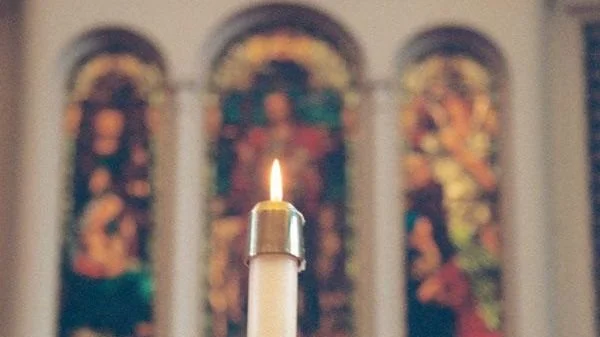
In that spirit, I’d like to express gratitude for those who, in response to fear, took action to make others safe: Sara Davis, Todd Johnson (who had the quick thinking to blow out the candles!), Allan Waite, Rich Puffert, Karl Nelson, James Haagenson, Colin Quackenbush, Heidi HansPetersen, Hans-Erik Blomgren, and many others. I am grateful for those who have been active in helping us to create our safety plans, like Rita Swanson and Deeann Puffert, and those who are looking for ways to strengthen these policies. And I am grateful that, whatever may come to First Covenant Church on Capitol Hill, we will be there to weather it together.
With gratitude for you and the God we serve,
~ Pastor Lauren